 Voyaggora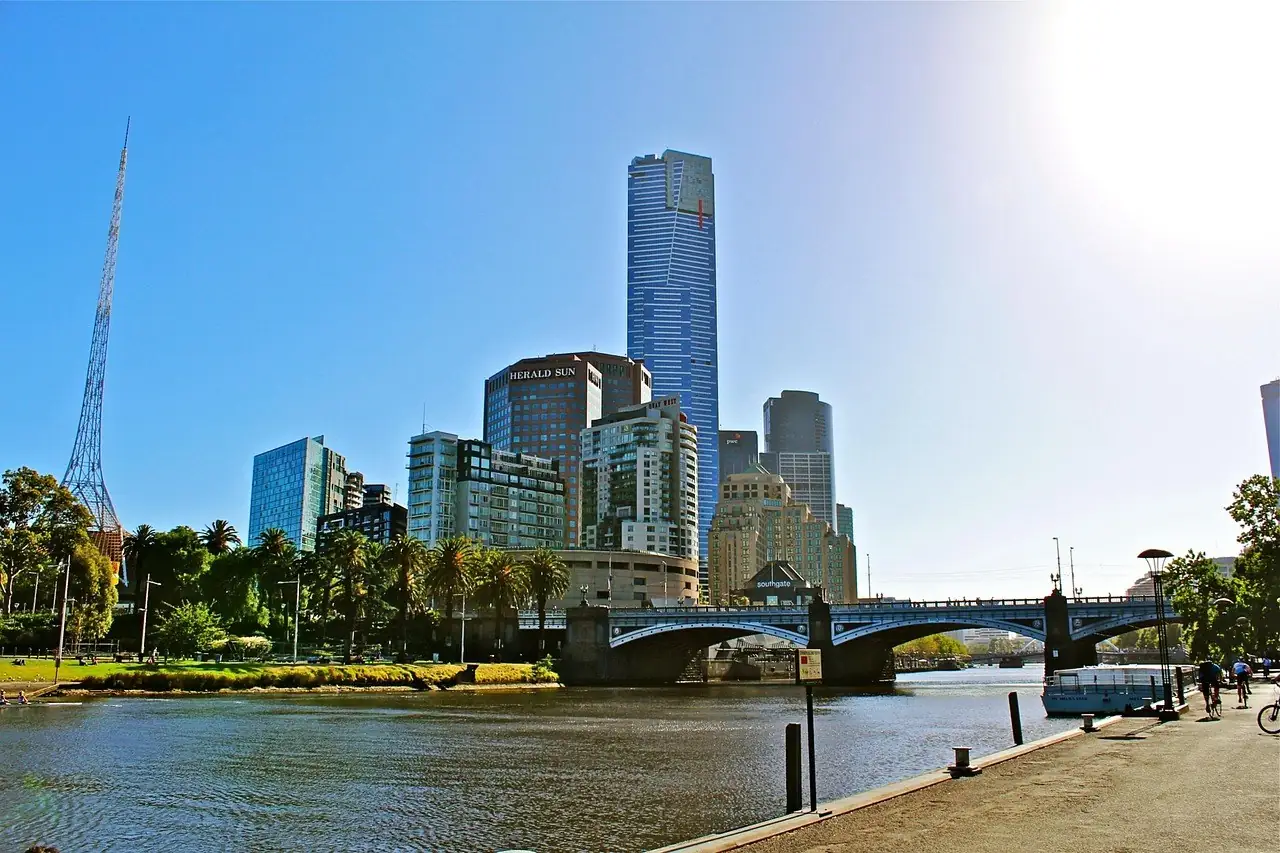
Top sights in Melbourne
- Federation Square – Public square in Melbourne, Victoria, Australia
- Royal Exhibition Building – Heritage building in Melbourne, Victoria, Australia
- Queen Victoria Market – Open-air market in Melbourne, Victoria, Australia
- Eureka Tower – Skyscraper in Melbourne, Victoria, Australia
- Royal Botanic Gardens Victoria – Botanic gardens at Melbourne and Cranbourne
- Melbourne Cricket Ground – Sports stadium in Melbourne, Victoria, Australia
- St Kilda, Victoria – Suburb of Melbourne, Victoria, Australia
Well-known landmarks, each checked against Wikidata (CC0), which also supplies the one-line descriptions. The bookable tours below are the second layer: guided ways to see them.
Top-rated tours in Melbourne
Planning your trip to Melbourne
Climate and seasons
Melbourne's climate is notorious for its changeability, often described as "four seasons in one day". It is generally temperate, with warm summers and cool winters. In summer (December to February) daytime temperatures average around 26 °C, but heatwaves above 35 °C and up to about 40 °C are not unusual. Annual rainfall is approximately 600 mm.
Getting around
Melbourne's CBD is laid out in an orderly grid, so it is easy to navigate. The public transport system of trams, trains and buses is comprehensive: trams criss-cross the city, trains extend to the outer suburbs and buses cover the rest. Transport Victoria's website and app have a journey planner.
Staying safe
Take care around tram lines: trams are heavy and can take over 100 metres to stop, and they often run nose-to-tail on busy streets such as Swanston Street. Driving in Melbourne can be nerve-wracking because of the trams, including the infamous "hook turn".
Summarised from Wikivoyage: Melbourne (CC BY-SA 4.0).
Where to stay in Melbourne
Hotels and vacation rentals around Melbourne with live prices from the big booking sites. Pick your dates on the map to compare.
Hotel map by our partner Stay22. If you book through it we may earn a commission, at no extra cost to you.
Best time to visit Melbourne
By temperature and rainfall alone, the most comfortable months in Melbourne are March to May and September to November, with average daytime highs of 61 to 75°F (16 to 24°C) and 8 to 14 rainy days a month. This is a weather-data pick that has not yet been checked against crowds, closures or local seasons. January is the hottest month, averaging 80°F (27°C), and July the coolest at 56°F (13°C). August sees the most rain, around 14 days, while February is the driest with about 6.
Jump to a month: Jan Feb Mar Apr May Jun Jul Aug Sep Oct Nov Dec
| Month | Avg high | Avg low | Rain (about, mm) | Rainy days | Verdict |
|---|---|---|---|---|---|
| January | 80°F (27°C) | 60°F (16°C) | 40 | 8 | Shoulder: 80°F (27°C), 8 rainy days |
| February | 77°F (25°C) | 58°F (14°C) | 50 | 6 | Shoulder: 77°F (25°C), 6 rainy days |
| March | 75°F (24°C) | 57°F (14°C) | 50 | 8 | Comfortable: 8 rainy days |
| April | 68°F (20°C) | 52°F (11°C) | 60 | 10 | Comfortable: 10 rainy days |
| May | 61°F (16°C) | 47°F (8°C) | 60 | 12 | Comfortable: 12 rainy days |
| June | 57°F (14°C) | 45°F (7°C) | 60 | 12 | Shoulder: 57°F (14°C), 12 rainy days |
| July | 56°F (13°C) | 44°F (7°C) | 60 | 12 | Shoulder: 56°F (13°C), 12 rainy days |
| August | 58°F (14°C) | 46°F (8°C) | 70 | 14 | Avoid: among the wettest, 14 rainy days |
| September | 63°F (17°C) | 47°F (8°C) | 60 | 13 | Comfortable: 13 rainy days |
| October | 66°F (19°C) | 49°F (9°C) | 60 | 14 | Comfortable: 14 rainy days |
| November | 71°F (22°C) | 54°F (12°C) | 70 | 11 | Comfortable: 11 rainy days |
| December | 75°F (24°C) | 56°F (13°C) | 60 | 8 | Shoulder: 75°F (24°C), 8 rainy days |
Average daily high and low, and days with rain (a day with at least 1 mm), from Open-Meteo ERA5 records for 2019-2024. Highlighted rows are the pick above. Verdicts use only these numbers.
Rainfall: NASA POWER monthly normals. Sea temperature: NOAA daily satellite data.
Plan the rest of your trip to Melbourne
More destinations in Australia & Pacific
Closest guides to Melbourne
Planning guides
Right now in Melbourne
Is it safe to travel to Australia right now?
Official US, UK and Canada travel advice for Australia, side by side, with each source and the time it was checked. See today's advisory for Australia
Melbourne: common questions
- When is the best time to visit Melbourne?
- By temperature and rainfall alone, the most comfortable months in Melbourne are March to May and September to November, when average highs run 61 to 75°F (16 to 24°C) with 8 to 14 rainy days a month. This is a weather-data pick, not yet checked against crowds, closures or local seasons. January is the hottest month at 80°F (27°C) on average, and July the coolest at 56°F (13°C).
- What is the rainiest month in Melbourne?
- August, with roughly 14 days of rain. The driest is February, with about 6. A rainy day is a day with at least 1 mm of rain; figures are averages from 2019-2024 records.
- How warm does it get in Melbourne?
- January is the warmest month, averaging 80°F (27°C) by day and 60°F (16°C) at night. July is the coolest, at 56°F (13°C) by day and 44°F (7°C) at night.
- What is the rainy season in Melbourne?
- The wettest months in Melbourne are May to November, with 11 to 14 rainy days a month. February is the driest.
- Is it safe to travel to Australia right now?
- Voyaggora shows the official US, UK and Canada travel advisories for Australia on one page, with the source and the time each was last checked. Open the live advisory for Australia before you book.
- What other places are near Melbourne?
- The closest Voyaggora guides to Melbourne are Sydney (440 miles), Gold Coast (840 miles), Brisbane (850 miles).
Some links on this page are sponsored: if you book through them we may earn a commission at no extra cost to you. Ratings and review counts come from GetYourGuide and were last checked on September 28, 2026. Prices, availability and rules are set by the providers and change often. See our affiliate disclosure.